It has been an odd year for movie musicals. Wicked: For Good earned half a billion dollars but received much less enthusiastic reviews than last years’ Wicked did. The film version of the Kander and Ebb musical Kiss of the Spider Woman earned only two million dollars at the box office despite enthusiasm for Jennifer Lopez’s performance. The real interest and excitement have been around musical films that defy conventional genre categories.
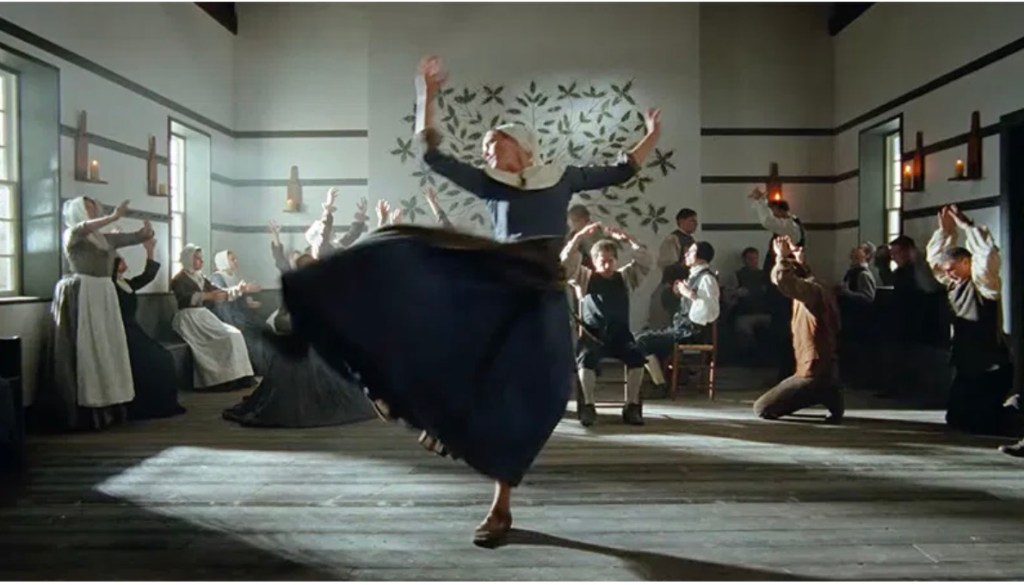
Music and Religious Ecstasy in The Testament of Ann Lee
The most artistically successful of these is Mona Fastvold’s The Testament of Ann Lee, a visually stunning biography of the spiritual leader of the 18th century Shaker religious movement. The film begins with Ann Lee’s childhood in Manchester, England. A poor girl who is sent out to work at an early age, Ann has religious visions but finds no meaning in the rituals of the patriarchal established church. As a young woman, she joins a group of Quakers who meet at an aristocratic home. Quaking turns into shaking as the group experiences religious ecstasy through song and dance. There Ann meets her husband, Matthew, a blacksmith. After years of succumbing without pleasure to Matthew’s erotic (for him) whippings and the loss of four children, Ann has a vision that people can only reach God through giving up Adam’s sin—fornication. Given the sexual humiliation she receives from her husband and the agony of four childbirths and the loss of those children—all graphically depicted in the film—release from sex is liberation for a woman of her class. Her younger brother William gives up his boyfriend to become her chief disciple. After being arrested in England, Ann and her followers decide to move to the United States. They establish a community in upstate New York which grows thanks to Williams’s and Ann’s preaching at nearby communities. Ann’s sexually frustrated husband leaves her, as does a young couple who want a complete life together. The Shakers endure a brutal attack from men who believe them to be witches and demons. Wiliam dies shortly after the attack; Ann, who was beaten and sexually assaulted, dies a year later. Fastvold’s screenplay, written with her life partner Brady Corbet (The Brutalist), uses voiceover narration and chapter headings to bridge the scenes that take place over decades.
So, The Testament of Ann Lee is the biography of a charismatic religious figure at the time of the founding of our nation. Ann Lee believed that women were the guides to salvation and that the second coming would be a woman. Like the Mormons a few decades later, her group faced violent opposition. Unlike the Mormons, it does not flourish, primarily because of the ban on sex. We see all kinds of hardship and cruelty imposed on the bodies of Ann and William, but we also see the spiritual ecstasy of song and dance for them and their followers.
The Testament of Ann Lee is unique in its use of musical numbers in a serious story, but there is no other way to show the ecstasy that was central to the Shakers’ worship. English composer Daniel Blumberg has taken old Shaker hymns and turned them into rapturous songs. Celia Rowlson-Hall’s choreography has been beautifully photographed, often with overhead shots that echo Busby Berkeley’s 1930s musical numbers. What I found fascinating is the ritualized orderliness of much of the dancing.
One of the film’s most powerful sequences takes place during the four-week sea voyage to the New World. The ship’s crew is at first hostile to the Shakers’ loud singing and dancing on the deck. After Ann’s heroic marshalling of her group during a storm that threatens to sink the ship, the crew comes to accept the strange, noisy religious practices of Ann and her followers.
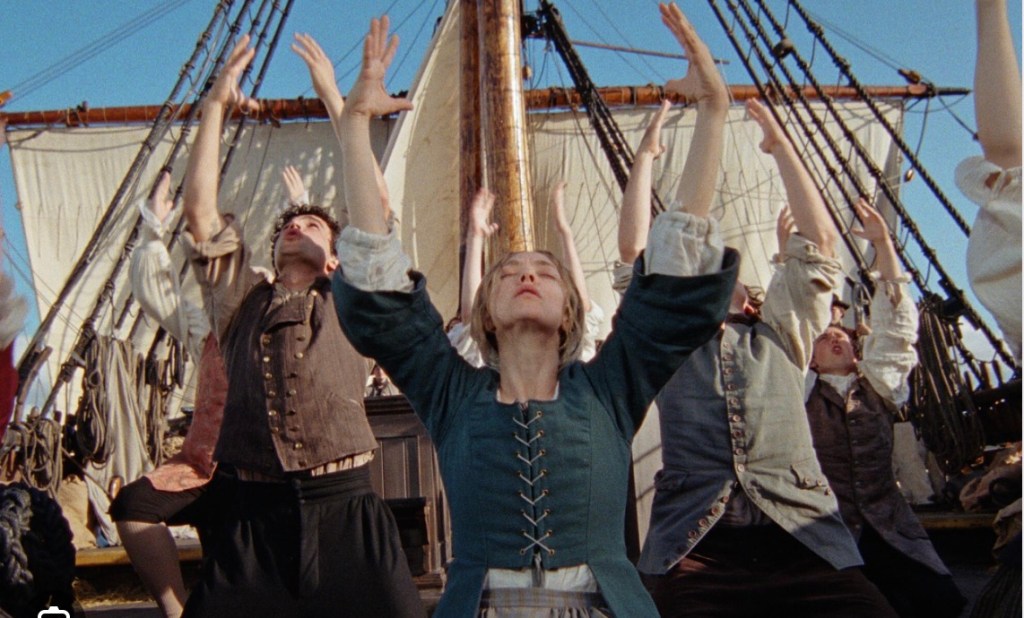
Shipboard worship in The Testament of Ann Lee
Fastvold effectively alternates long shots with close ups that look like old portraits. Amanda Seyfried meets the challenge of playing this charismatic religious leader. Ann had the force of personality to convince her followers that a woman could be a religious leader. She also had the power to convince them to give up sex and to cross the Atlantic to an unknown land. Seyfried manages to convey both spiritual power and vulnerability. My vote for Best Actress Oscar has switched from Jessie Buckley to Seyfried. I hope that the Academy has the sense to nominate her.
Filmed in Hungary and Sweden, as well as in New England, The Testament of Ann Lee looks convincingly like it takes place in the eighteenth century. The film is a totally absorbing hybrid that gives us a sense of the rapture that the Shakers experienced in violent, challenging times.
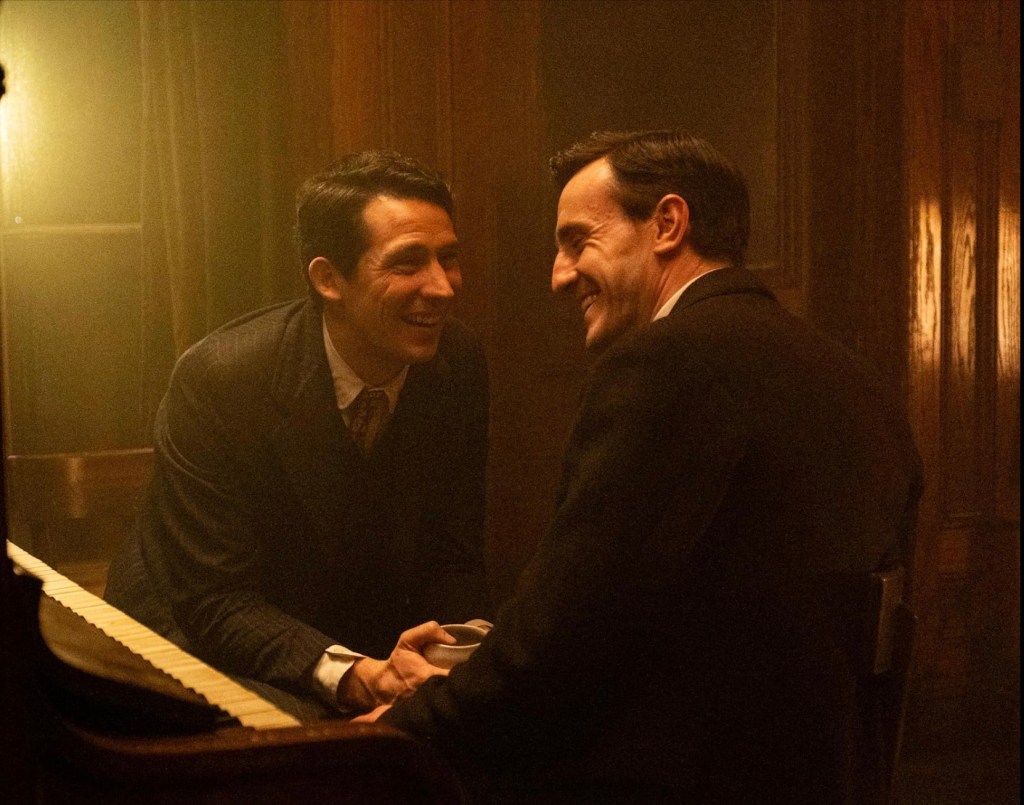
David and Lionel fall in love in The History of Sound
The History of Sound is another hybrid: part love story, part musical. In 1917, Lionel (Paul Mescal), who has been raised on a poor Kentucky farm, is given a scholarship to the New England Conservatory of Music. At a local bar, Lionel meets a fellow student, David (Josh O’Connor). Before the night is out, Lionel is in David’s bed, but their romance is short-lived. David is sent off to war. Lionel, whose poor eyesight exempts him from military service, returns to the family farm. A couple of years later, David, now a professor of music at Bowdoin College, sends Josh a letter inviting him to join David on a trip through Maine where they will research folk songs. With the help of a windup wax cylinder recorder, they capture folk songs. The trip allows them to rekindle their relationship, but at the end of the summer, they have to part ways again. Lionel moves on to Europe. He leaves a conducting job and a boyfriend in Italy and moves on to England where he again leaves a good job and a wealthy girlfriend. He is drawn back to the States to find David, who has never answered his letters. At Bowdoin, he discovers that the college knows nothing about David’s research trip and that David, suffering from PTSD, killed himself. He also discovers that David was married when he traveled with Lionel and that he had a child. Eventually Lionel becomes a celebrated ethnomusicologist.
The History of Sound is a lovely film, perhaps too muted in its telling of the love of the two men. David is never honest with Lionel about the extent to which the war traumatized him or about his marriage and Lionel doesn’t express much shock at learning of David’s deceptions. In the process of avoiding melodrama, writer Ben Shattuck and director Oliver Hermanus suck some of the blood out of their story
The History of Sound isn’t Josh O’Connor’s first gay love story. His first major film was Francis Lee’s beautiful God’s Own Country, in which O’Connor plays a deeply unhappy young Yorkshire farmer who falls in love with a Romanian man who comes to help on the farm. God’s Own Country is a classic of gay cinema greatly because of O’Connor’s performance. In The History of Sound, O’Connor’s David never fully admits to Lionel his pain or his marital situation. What is he looking for in his trip to Maine with Lionel? Escape from his demons? A return to a youthful romance that brought him happiness? O’Connor is brilliant at showing a character battling against emotional pain. That’s even evident in his superb performance in the Knives Out film, Wake Up Dead Man. Paul Mescal has the longer but easier role. As usual, he exudes enormous charm.
As good as Mescal and O’Connor are, the most radiant scenes in The History of Sound are of country folk singing into that wax cylinder recorder. Even in drab, humble circumstances, the singers radiate joy through the art (artlessness, really) of their singing. It’s the musical moments I remember most vividly.

The magical, musical K-Pop demon hunters.
The Golden Globe for best animated film and for best song went to the Netflix film K-Pop Demon Hunters, which has become the most watched original title in Netflix history, racking up more that 500 million views so far. To appreciate the film, it helps to understand the success of the South Korean phenomenon K-Pop with its crazily costumed and energetic male and female singing and dancing groups. K-Pop is aimed at teenagers, of course, but K-Pop Demon Hunters about a girl singing group who—you guessed it—hunt demons. The demons have created a boy group who are out to corrupt millions of fans with their catchy songs. The film silly but highly entertaining. The wildly colorful animation is mesmerizing and the music is infectious. This is a delicious dessert of a film.
 John Clum's Theater, Music, Film and Media Reviews