Among the unexpected delights of our travels to Japan were visits to out-of-the-way small towns inhabited mostly by elderly people, the result of young people moving to the city for employment. The town of Joge, near Hiroshima, once was a prosperous town because of the silver trade. It even has a lovely 19th century Kabuki theatre. Now the senior inhabitants welcome tourist groups with martial arts demonstrations, tours of the lovely little town, and lunch at a cozy restaurant. There is also an antique store that is a treasure trove for collectors of Japanese art. On another trip, we visited a country village where locals put on a puppet show and taught us how to create a Japanese lunch. We also visited the town’s famous creator of indigo fabrics using traditional methods. Japan has a number of these old villages whose population has dwindled to a handful of elderly people. This is not surprising in a country where one-third of the population is over sixty-five.
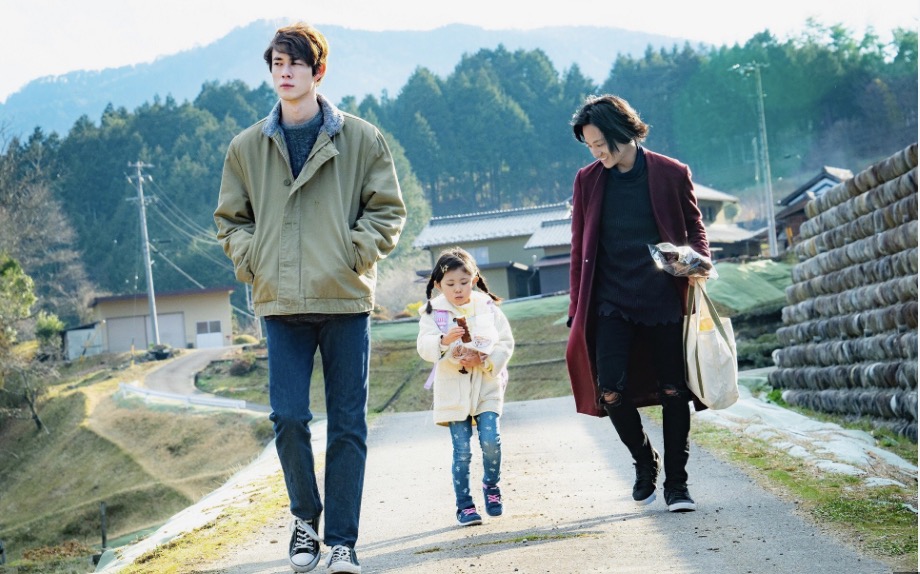
Lovers Shun and Nagisa and Nagisa’s daughter in HIS
I thought about our visits to these towns as I watched the excellent lgbt-themed film His (available on YouTube). I had seen the 2020 film a couple of years ago but was recently drawn back to it. I have not seen another Japanese film that so deftly combines the prejudice against gay people in Japan with the problems of Japanese working women.
The film begins with two young men, Shun and Nagisa, in bed together. A sense of happy intimacy is broken when Nagisa says that he wants them to break up. Cut to Shun waking up years later in his Spartan house in a small town. We see him silently go through his morning routine of picking vegetables from his garden, trading some with a kind old man for meat, and reading by the river. Shun had a job in Tokyo but retreated when word got out about his former relationship with Nagisa. Because of his own shame, he couldn’t deal with the homophobic taunting from his colleagues.
Shun’s quiet routine is broken when he returns home to find Nagisa waiting outside with his six-year-old daughter, Sora. After they broke up, Nagisa, who panicked at the prospect of a gay life that would not be accepted, moved to Australia and married Rena. Since Sora’s birth, he has been househusband while she developed a career as an interpreter. This gender reversal is highly unusual in Japan. Eventually Nagisa accepted that his attraction was to men. After a spate of promiscuity, he realized that he really wanted a full relationship with Shun, who can’t resist allowing Nagisa and Sora to move in with him.
When Rena takes Sora back to Tokyo with her, Shun and Nagisa renew their sexual relationship. Rena has difficulty balancing the demands of her job with raising Sora who returns to her father and Shun in the village. The girl inadvertently outs her father and his lover to the elderly villagers.
A major element of the film is Shun’s and Nagisa’s acceptance of their homosexuality. They both have suffered from internalized homophobia but find this small community one in which they can accept themselves and be accepted. We see through Nagisa and Rena’s custody battle that such acceptance is not as true in the legal world. Nor is it easy for a single mother like Rena to receive the support of the legal system. The assumption of Japanese society is that a man is the breadwinner and a woman rears the children. The cards seem to be stacked against both parents in their custody battle. Six-year-old Sora just wants to be with both parents and Shun.
The slow pace of His—typical of many Asian films—might irritate some viewers, but Rikiya Imaizumi’s direction gives the viewer a sense of the relaxed pace of life in a rural community. The pace also allows the viewer to concentrate on characters’ reactions to situations. The characters aren’t big talkers, so we depend on body language and facial expression.
There are a number of heart-rending moments the film, which is as compassionate with the female characters as it is with the gay lovers. We watch Rena gradually get better at mothering. She also realizes that she will have to find a place for her ex-husband and his partner in her and Sora’s lives.
Essentially the film is about three people growing up. Shun cannot spend his life avoiding people or denying his sexual orientation. Nagisa has to accept the consequences of his love for Shun. Rena has to learn the difficult balance of work and family. At the center of the film is a six-year-old girl all three grownups love but has no say in the compromises the characters make for her. For Shun and Nagisa, the friendly small town is a better environment for their coming out than the big city. His has become one of my favorite recent films.
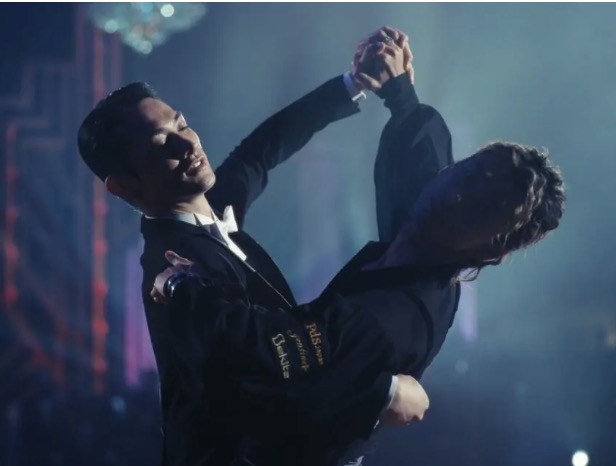
True partnership in 10 Dance
The first thing we see on the screen in the imperfect but sexy as hell Japanese film 10 Dance is a quotation from Aristotle, “Love is composed of a single soul inhabiting two bodies.” Keishi Ohtamo’s film, based on a manga series by Inouesatoh, doesn’t quite take us to this Aristotelian ideal, but the film’s climactic dance routine gets us close. 10 Dance is a somewhat heated rivalry between two male ballroom dancers. Their dance routines require a delicate balance of dominance and submission. Can these two men overcome the need for dominance off the ballroom floor?
Shinya Suzuki (the fabulous Ryuma Takeuchi) and Shinya Sugiki (Keita Machida) are both competitive ballroom dancers. Sugiki is the hyper-controlled master of traditional ballroom steps. Once can see in his perfectly groomed appearance his rage for order. He never quite reaches the top of his profession because some key element is missing. His mentor tells him, “Dance is neither about technique nor stamina. Love is what makes it whole.” The implication is that Sugiki is missing love—for dance and for his partner. He is all determination. His previous partner and lover left him because she wanted to win and she knew something was missing from their routines. Sugiki has been a secret admirer of his opposite, Shinya Suzuki, a specialist in Latin steps. Suzuki is blonde where Sugiki is dark, fiery where Sugiki is chilly. Sugiki knows he needs some of Suzuki’s fire—and that Suzuki could use something of Sugiki’s discipline. So Sugiki dares Suzuki to train with him for the brutal 10 Dance competition, which requires mastery of ballroom and Latin dances.
Things get a bit hot as soon as the men and their partners start training together at Sugiki’s dance studio. Suzuki takes off his shirt and makes Sugiki hold his hips to show him how to loosen up his torso. Dance to Suzuki is sexy. Sugiki tells his rival that he will only understand ballroom dancing if he takes the role of the submissive partner—the woman’s role.
A more conventional film would have the two men making out on the dance floor, but that would be out of character for Sugiki. Neither man is gay (though neither is completely straight) but there is electricity between them. There’s a passionate kiss on a train that doesn’t seem to lead anywhere. Later, when they are in an international competition in Blackpool, England, a drunk Suzuki pushes Sugiki down onto the bed and kisses him passionately. Sugiki resists, admitting that if he gives in, he will be lost. He’s not terrified of giving into sex with Suzuki, but allowing himself to be dominated. “We can never become one,” he says.
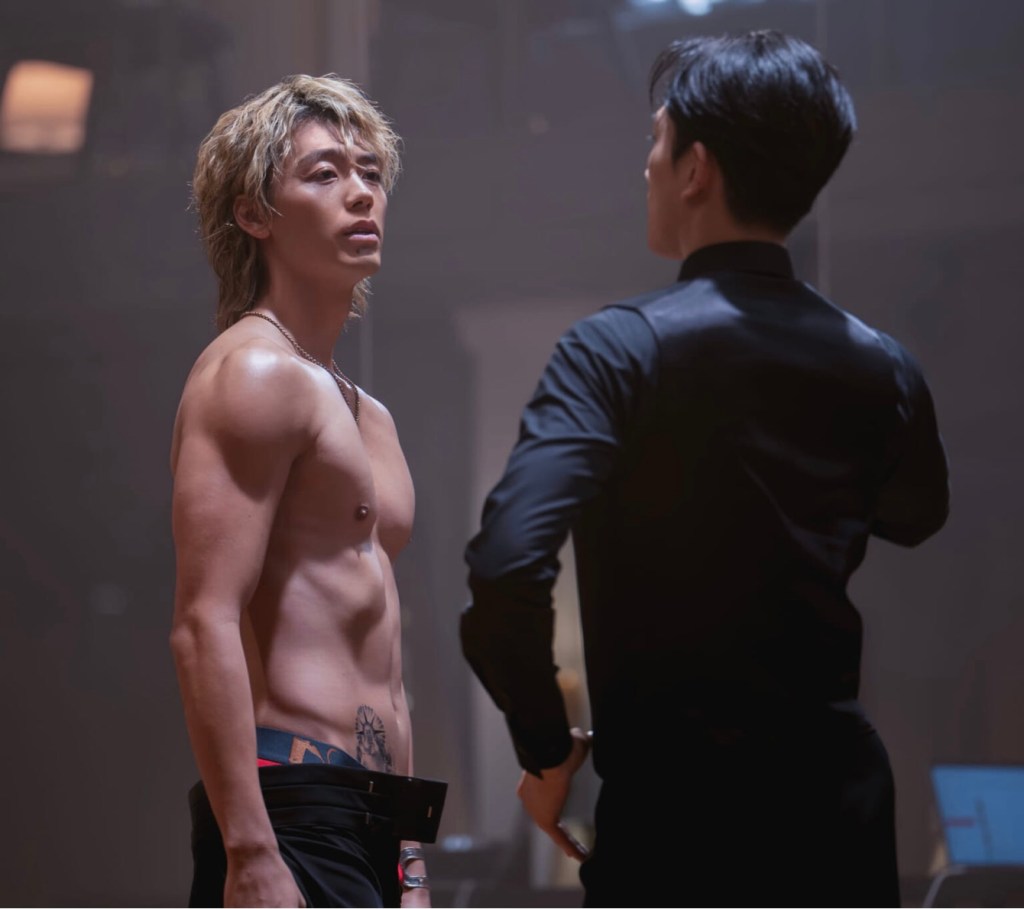
Fire and ice: Ryuma Takeuchi and Keito Machida in 10 Dance
In a fantasy finale, the two men briefly become one on the dance floor. At a new international dance competition in Japan, Sugiki and his partner are asked to do a demonstration of the ten dances. Sugiki appears without his female partner and asks Suzuki to take the female role in the demonstration. The two men show their mastery of the ten dances in front of a cheering audience. At the end, they kiss but walk off separately.
10 Dance would be better as a series than as a two-hour feature film. Important scenes seem to be missing. However, the relationship between the two men is fascinating and Ryuma Takeuchi and Keito Machida brilliantly outline the complex relationship between these two men. You can almost feel the sexual heat coming off of Takeuchi, who is always a magnetic performer. It is amazing that these two actors without previous dance training turn into a male-male Fred and Ginger team. The dance finale is amazing.













 John Clum's Theater, Music, Film and Media Reviews